Smoke Smell in a Car: Removal Guide for Cigarette Odor
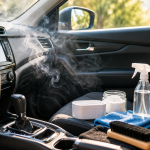
Yes, cigarette smoke smell can often be greatly reduced or removed from a car, but simply opening the windows or adding an air freshener usually does not solve an established odor. Smoke residue settles on seats, carpet, the headliner, glass, hard surfaces and parts of the ventilation system.
The most effective approach is to remove ash and debris, clean every contaminated surface, check or replace the cabin air filter, address the HVAC system if the smell comes through the vents, and let the interior dry completely before using any additional odor-neutralizing treatment.
Can You Get Smoke Smell Out of a Car?
In many cases, yes.
How completely the smell can be removed depends on how heavily and how long the vehicle was exposed to cigarette smoke.
A car that was smoked in once or twice may respond well to thorough cleaning and ventilation. A heavily smoked-in used car can be more difficult because tobacco residue may be present throughout porous materials, including seat fabric, padding, carpet and the headliner.
Research on thirdhand smoke has found persistent nicotine contamination on surfaces in cars where smoking occurred, confirming that tobacco pollution does not remain only in the air.
PubMed — Thirdhand Smoke Contamination on Surfaces
That is why the goal should be to remove the residue that produces the smell, not simply cover it with another fragrance.
Why Cigarette Smell Stays in a Car
Cigarette smoke travels throughout a vehicle and leaves residue on many different materials.
Common contamination areas include:
- cloth or leather seats;
- seat foam;
- carpet;
- floor mats;
- headliner;
- dashboard;
- plastic trim;
- steering wheel;
- windows;
- air vents;
- cabin air filter.
Smoke also leaves an oily-looking film on interior glass and other hard surfaces.
This explains why airing out the car can make it smell better temporarily without solving the underlying problem. The odor is not just floating in the cabin air — some of its sources remain on and inside the interior materials.
Best Way to Remove Smoke Smell From a Car
For established cigarette odor, clean the car in a logical order:
- Remove cigarettes, ash and trash.
- Empty personal items from the vehicle.
- Vacuum seats, carpet and crevices thoroughly.
- Clean cloth seats and carpet.
- Clean leather seats if applicable.
- Wipe dashboard, doors and other hard surfaces.
- Clean all interior glass.
- Carefully clean the headliner.
- Check or replace the cabin air filter.
- Address the HVAC system if smoke odor comes through the vents.
- Allow everything to dry and ventilate the car.
- Consider professional odor treatment if the smell remains.
Do not begin with perfume, an air freshener or an “odor bomb.” These products may make the cabin smell different for a while, but they do not remove smoke residue from the materials underneath.
Remove Ash and the Original Odor Sources
Before using any wet cleaner, remove obvious sources of tobacco odor.
Check:
- ashtrays;
- cupholders;
- door pockets;
- under the seats;
- seat rails;
- floor mats;
- trunk;
- storage compartments.
A cigarette butt, spilled ash or a smoke-contaminated loose item can keep producing odor even after the visible interior has been cleaned.
Then vacuum thoroughly.
Pay particular attention to:
- seat seams;
- gaps around the center console;
- carpet edges;
- beneath removable mats;
- trunk carpeting.
Removing dry contamination first prevents you from turning ash and dust into wet residue during the next cleaning steps.
Clean Cloth Seats and Carpet
Fabric and carpet can retain cigarette odor particularly well.
For cloth seats:
- Vacuum thoroughly.
- Apply an automotive upholstery cleaner according to its instructions.
- Agitate gently with an appropriate soft brush if required.
- Blot or extract the cleaning solution and residue.
- Allow the seats to dry completely.
For the carpet:
- Remove the floor mats.
- Vacuum the carpet and mats.
- Treat them with a suitable automotive carpet cleaner.
- Work on heavily contaminated areas as directed.
- Extract or remove residue where possible.
- Dry everything thoroughly.
Avoid soaking the seats or carpet.
Too much moisture can penetrate padding, dry very slowly and replace the cigarette smell with another problem, such as a musty odor or mildew.
If smoke has penetrated deeply into seat foam, one surface cleaning may not be enough.
Clean Leather Seats and Interior Trim
Leather needs a different approach from cloth upholstery.
Start by vacuuming seams, then use a cleaner specifically suitable for automotive leather. Wipe away residue and follow the vehicle or product manufacturer’s instructions if using a conditioner.
Do not assume a strong household degreaser is appropriate for leather.
Hard surfaces also need attention because cigarette residue settles throughout the cabin.
Clean areas such as:
- dashboard;
- steering wheel;
- center console;
- door panels;
- plastic trim;
- handles;
- other frequently touched surfaces.
Work in small sections and use products compatible with the material you are cleaning.
Clean the Inside of the Windows
Interior glass is easy to overlook during smoke odor removal.
Cigarette smoke can leave a film on:
- the windshield;
- side windows;
- rear glass.
Use an automotive glass cleaner with a clean microfiber cloth, then finish with a second dry microfiber to remove remaining streaks and residue.
Do not use the same cloth you used on the dashboard. Interior protectants and cleaners left in that cloth can spread oily residue back onto the glass.
Cleaning the windshield is worthwhile even apart from the smell because a smoke film can make the glass hazy, particularly when driving toward bright lights or sunlight.
Clean the Headliner Carefully
The headliner is an important part of cigarette odor removal because smoke rises and residue can accumulate overhead.
It is also one of the easiest interior surfaces to damage.
Avoid:
- saturating it with cleaner;
- aggressive scrubbing;
- heavy extraction unless you know the material can tolerate it.
Many headliners use fabric bonded to a foam-backed layer. Too much moisture or aggressive cleaning can weaken the adhesive and cause sagging or separation.
Use as little moisture as necessary and follow the cleaner and vehicle manufacturer’s recommendations. If the headliner is heavily contaminated, this is one area where professional cleaning may be safer.
Smoke Smell From the Car Air Conditioner
If the cigarette smell becomes stronger when you turn on the fan, heat or air conditioning, cleaning the visible cabin may not be enough.
Smoke contamination can involve:
- the cabin air filter;
- air vents;
- parts of the HVAC system.
Check the Cabin Air Filter
A cabin air filter that has been exposed to cigarette smoke can hold odor and redistribute it when air moves through the system.
If the filter is dirty or smells of smoke, replacement may help.
Do not assume replacing the filter alone will cure a heavily contaminated vehicle, however. It is only one potential source.
Address Persistent HVAC Odor
If a clean interior and fresh cabin filter do not solve odor coming from the vents, the HVAC system may need further treatment.
Use only products specifically intended for automotive HVAC systems and follow their instructions.
Do not spray random household cleaners into the air intake or vents. Persistent contamination may justify professional evaporator or ventilation-system cleaning.
Does Airing Out a Car Remove Cigarette Smell?
Airing out the car helps, but it usually does not remove established cigarette odor by itself.
Ventilation is useful:
- after recent, light smoke exposure;
- during and after cleaning;
- while damp upholstery is drying.
But once tobacco residue has settled into fabric, foam, carpet, the headliner and ventilation components, opening the windows mainly removes airborne odor.
Think of airing out as a finishing and drying step rather than a substitute for cleaning.
Smoke Smell in a Used Car
If a used car smells like cigarette smoke, consider how severe the contamination appears before deciding whether a simple DIY cleaning is likely to be enough.
Mild Smoke Smell
For relatively light odor, you may only need:
- thorough vacuuming;
- upholstery and carpet cleaning;
- hard-surface cleaning;
- glass cleaning;
- a new cabin air filter;
- ventilation.
Heavy Smoker’s Car
A car that was smoked in regularly for years can have residue in:
- seat foam;
- headliner;
- carpet padding;
- HVAC components;
- multiple porous interior materials.
A thorough detail can make a major difference, but no reputable method can guarantee that every heavily contaminated car will become completely odor-free.
In severe cases, repeated cleaning or replacement of particularly contaminated porous materials may be necessary.
Can Professional Car Detailing Remove Smoke Smell?
Professional detailing can often substantially reduce or remove cigarette odor, especially when the service involves more than a basic wipe-down.
For smoke remediation, ask whether the service includes:
- deep vacuuming;
- cloth seat and carpet extraction;
- cleaning of hard surfaces;
- headliner treatment;
- interior glass;
- cabin air filter inspection or replacement;
- HVAC treatment;
- odor neutralization.
Do not assume a standard “interior detail” automatically includes cigarette smoke removal.
Before booking, ask:
- Do you specifically treat tobacco smoke?
- Do you clean the headliner?
- Is seat and carpet extraction included?
- Do you treat smoke odor from the HVAC system?
- Is cabin air filter replacement included?
- Is odor-neutralizing treatment an extra service?
For a heavily smoked-in used vehicle, a dedicated smoke-removal detail may be more practical than buying a series of stronger DIY products.
Should You Use an Ozone Generator?
Ozone is sometimes used by professional remediation services after physical cleaning, but it should not be treated as a simple DIY shortcut.
EPA warns that ozone can harm health when inhaled. It also says that ozone concentrations low enough to remain within public-health standards are generally ineffective at removing many indoor contaminants.
At higher concentrations, ozone can react with other chemicals and can damage materials including rubber, fabrics and electrical-wire coatings.
EPA — Ozone Generators That Are Sold as Air Cleaners
Do not occupy a vehicle during ozone treatment, and do not treat ozone as the first or only smoke-removal step.
There is no safe universal instruction such as “run an ozone machine for 60 minutes.” Equipment output, cabin size and resulting ozone concentration differ substantially.
For severe smoke odor where ozone treatment is being considered, professional odor remediation is the more appropriate approach.
Do Baking Soda, Vinegar and Air Fresheners Work?
Baking Soda
Baking soda may absorb some odor in carpet or fabric, but it does not remove all tobacco residue from a vehicle.
Vinegar
Vinegar should not be treated as a universal automotive cleaner. Leather, screens, coated trim and other materials can have different care requirements.
Air Fresheners
Air fresheners primarily add another fragrance.
They may temporarily make a car smell better while the original cigarette residue remains.
Automotive Odor Neutralizers
A suitable odor-neutralizing product can be useful after the source has been physically cleaned.
The basic rule is:
clean first, deodorize second.
Mild Smoke Smell vs. Heavy Smoke Contamination
For mild, recent smoke exposure, a DIY cleaning may be enough.
Start with:
- removing ash;
- vacuuming;
- wiping hard surfaces;
- cleaning fabric;
- cleaning glass;
- airing out the vehicle.
For an established smoker’s car, expect to address more areas:
- upholstery extraction;
- carpet;
- headliner;
- cabin air filter;
- HVAC;
- professional odor treatment if necessary.
There is no reliable number of cleaning sessions that works for every vehicle.
What If a Rental Car Smells Like Smoke?
If a rental car already smells like cigarette smoke when you pick it up, do not begin deep-cleaning someone else’s vehicle.
Document the condition and contact the rental company before leaving the location when possible.
Avis, for example, states that its U.S. fleet is smoke-free and recommends inspecting the vehicle before departure. If the car is not satisfactory, customers are told to speak with the rental counter; another vehicle may be provided if one is available.
Reporting the problem immediately also reduces the risk of a later dispute over who caused the smoke smell.
What If the Car Suddenly Smells Like Burning Smoke?
A new burning smell is different from stale cigarette odor.
If you notice:
- burning plastic;
- burning rubber;
- burning oil;
- a sharp electrical smell;
- visible smoke;
do not try to solve the problem with interior cleaner or deodorizer.
Potential causes include overheated brakes, fluid contacting hot components, belts, wiring or other electrical and mechanical faults.
If the smell is strong or persistent, or it is accompanied by visible smoke, warning lights or abnormal vehicle behavior, pull over safely and have the vehicle checked rather than continuing to drive.
Getting cigarette smell out of a car usually requires cleaning every place the smoke reached, not simply covering the odor. Seats, carpet, the headliner, hard surfaces and the ventilation system should all be addressed, and a contaminated cabin air filter may need replacement. If a heavily smoked-in used car still smells after thorough cleaning, professional smoke-removal detailing is usually more practical than repeatedly adding stronger fragrances or attempting aggressive DIY ozone treatment.
Comments are closed