Aerosols on Planes: Dry Shampoo, Hairspray and TSA Rules
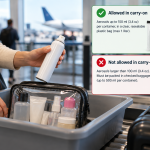
Yes, many personal-care aerosols can go on a plane. Dry shampoo, hairspray and spray deodorant are generally allowed in U.S. carry-on baggage when each container is 3.4 oz (100 ml) or smaller and follows the TSA 3-1-1 rule. Larger permitted toiletry aerosols can usually travel in checked baggage, where FAA rules allow containers up to 18 oz (0.5 kg) or 17 fl oz (500 ml), with an aggregate limit of 70 oz (2 kg) or 68 fl oz (2 L) per passenger.
The important distinction is that personal-care aerosols are allowed under specific exceptions; not every aerosol product is permitted on an airplane.
Can You Bring Aerosols on a Plane?
Many ordinary toiletry and medicinal aerosols are permitted on U.S. flights.
Examples include:
- dry shampoo;
- hairspray;
- spray deodorant;
- shaving cream;
- aerosol sunscreen;
- certain medicinal sprays.
For carry-on baggage, TSA applies its 3-1-1 liquids rule to liquids, aerosols, gels, creams and pastes. Each container generally must hold no more than 3.4 oz or 100 ml, and these items must fit in the permitted quart-size liquids bag.
Checked baggage allows larger personal toiletry aerosols, but FAA hazardous-material rules still impose limits.
Aerosol Carry-On and Checked Bag Limits
| Item / rule | Carry-on | Checked baggage |
|---|---|---|
| Dry shampoo aerosol | Yes, ≤3.4 oz / 100 ml | Yes |
| Hairspray | Yes, ≤3.4 oz / 100 ml | Yes |
| Spray deodorant | Yes, ≤3.4 oz / 100 ml | Yes |
| Shaving cream aerosol | Yes, ≤3.4 oz / 100 ml | Yes |
| Toiletry aerosol container | ≤3.4 oz / 100 ml | ≤18 oz / 0.5 kg or 17 fl oz / 500 ml |
| Total restricted medicinal/toiletry quantity | Must fit TSA 3-1-1 rules | ≤70 oz / 2 kg or 68 fl oz / 2 L per passenger |
| Aerosol release device | Must be protected | Must be protected |
The FAA aggregate quantity applies to the restricted medicinal and toiletry articles you are carrying together, rather than giving you a separate maximum allowance for every type of aerosol.
Can You Bring Dry Shampoo on a Plane?
Yes. TSA specifically lists aerosol dry shampoo as permitted in both carry-on and checked baggage, subject to the applicable limits.
Dry Shampoo in a Carry-On
For carry-on luggage, the aerosol can must generally be:
3.4 oz / 100 ml or smaller.
It also needs to fit with your other liquids, gels, creams and aerosols in the TSA 3-1-1 bag.
A large dry-shampoo can is not allowed through the checkpoint simply because there is only a small amount left inside it. TSA’s rule is based on the capacity of the container, not the amount of product remaining.
Dry Shampoo in Checked Luggage
A larger personal-use dry-shampoo aerosol can normally be packed in checked baggage if it stays within the FAA medicinal/toiletry limits.
Each container must not exceed:
- 0.5 kg / 18 oz by mass, or
- 500 ml / 17 fl oz by volume.
The total restricted medicinal and toiletry articles carried by one passenger must stay within:
- 2 kg / 70 oz, or
- 2 L / 68 fl oz.
Is Dry Shampoo a Liquid According to TSA?
It is more accurate to say that aerosol dry shampoo is regulated under TSA’s liquids, aerosols, gels, creams and pastes rule.
The issue is not whether the material inside the can would technically be classified as a liquid or powder.
Because it is an aerosol, TSA applies the same 3.4-ounce / 100-ml carry-on container limit.
So a full-size aerosol dry shampoo cannot bypass the 3-1-1 rule simply because it sprays out as a powder.
Can You Bring Hairspray on a Plane?
Yes.
Hairspray is one of the personal toiletry aerosols specifically covered by U.S. passenger baggage rules.
Carry-on
Aerosol hairspray must generally be in a container of:
3.4 oz / 100 ml or less.
It belongs in your 3-1-1 liquids bag with other regulated toiletries.
Checked baggage
Larger hairspray containers can be permitted in checked baggage as long as they remain within the FAA limits for individual containers and total medicinal/toiletry quantity.
The spray button or nozzle must also be protected against accidental release.
FAA — Medicinal and Toiletry Articles
Is Hairspray Considered a Liquid by TSA?
Aerosol hairspray falls under TSA’s liquids-and-aerosols 3-1-1 rule when you carry it through airport security.
That means a full-size aerosol can is not allowed in carry-on luggage merely because the product is sprayed rather than poured.
For normal carry-on travel:
maximum container capacity = 3.4 oz / 100 ml.
Can You Bring Spray Deodorant on a Plane?
Yes, ordinary personal-use spray deodorant is generally permitted.
In a Carry-On
An aerosol deodorant container must generally hold no more than:
3.4 oz / 100 ml.
It is subject to the same TSA 3-1-1 rule as other toiletry aerosols.
In a Checked Bag
A larger permitted spray deodorant may be checked if:
- each container stays within the FAA 18 oz / 0.5 kg or 500 ml / 17 fl oz maximum; and
- your combined restricted medicinal and toiletry quantity remains within the 70 oz / 2 kg or 68 fl oz / 2 L passenger limit.
Solid stick deodorant is different. Because it is solid, it is not subject to the standard 3.4-ounce liquids/aerosols carry-on limit.
What Size Aerosol Can Can You Take on a Plane?
This is where travelers often mix up two different rules.
Carry-On Aerosol Limit
At a U.S. TSA checkpoint, liquids, gels and aerosols generally must be in containers no larger than:
3.4 oz / 100 ml each.
A 5-ounce aerosol can does not become acceptable because it is almost empty.
Container capacity is what matters.
Checked Baggage Aerosol Limit
For permitted medicinal and toiletry aerosols, the FAA allows each container to have a capacity of up to:
0.5 kg / 18 oz or 500 ml / 17 fl oz.
The total restricted medicinal and toiletry quantity per passenger cannot exceed:
2 kg / 70 oz or 2 L / 68 fl oz.
So remember:
Carry-on: 100 ml maximum per container under the TSA rule.
Checked baggage: up to 500 ml per permitted toiletry container under FAA limits.
Can Aerosol Cans Go in Checked Luggage?
Many personal-care aerosol cans can. But checked baggage does not make every aerosol legal.
Examples of commonly permitted toiletry aerosols include:
- dry shampoo;
- hairspray;
- spray deodorant;
- shaving cream;
- sunscreen sprays.
The FAA has a passenger baggage exception for limited quantities of medicinal and toiletry articles.
But flammable aerosols that do not qualify as medicinal or toiletry products can be prohibited in both carry-on and checked bags.
Examples include many:
- spray paints;
- WD-40-type products;
- spray starches;
- cooking sprays.
Always identify what the product actually is rather than assuming the word “aerosol” determines whether it is allowed.
What Is Considered an Aerosol?
For transportation purposes, the FAA describes an aerosol as a product in which compressed gas is used to expel another material.
That material might be:
- liquid;
- powder;
- cream.
Common personal-care examples include:
- dry shampoo;
- hairspray;
- spray deodorant;
- shaving cream;
- aerosol sunscreen.
That is different from a cylinder in which the compressed gas itself is the product. Pressurized oxygen cylinders, scuba tanks and certain other gas cylinders are regulated under different rules.
Will Dry Shampoo Explode on a Plane?
An intact, permitted dry-shampoo can that is properly packed within TSA and FAA limits is allowed for air travel. But aerosol cans are pressurized containers, so it would also be inaccurate to say that they can never leak, rupture or create a hazard.
Do not travel with an aerosol can that is:
- leaking;
- badly dented;
- damaged;
- missing protection over an easily activated nozzle.
Aerosols should also be kept away from excessive heat.
The FAA allows ordinary toiletry aerosols in limited quantities because specific passenger-baggage exceptions and packaging requirements are designed to manage the risk.
There is therefore no reason to assume that a normal travel-size dry shampoo will automatically “explode on a plane,” but it should still be treated as a pressurized product and packed correctly.
How to Pack Aerosol Cans for Flying
In Carry-On Baggage
For an ordinary toiletry aerosol:
- Check that the product itself is permitted.
- Use a container no larger than 3.4 oz / 100 ml.
- Put it in your TSA 3-1-1 liquids bag.
- Keep the protective cap or other nozzle protection in place.
In Checked Baggage
Before packing:
- Confirm that it qualifies as a permitted toiletry or medicinal aerosol.
- Check the container capacity.
- Make sure your total restricted toiletry quantity remains within FAA limits.
- Protect the spray button or nozzle against accidental activation.
- Do not pack damaged or leaking cans.
FAA rules specifically require release devices on permitted aerosol toiletries to be protected by a cap or other suitable means.
You can also place the aerosol in a toiletry bag or among soft clothing to reduce movement and physical damage.
A separate plastic bag may be convenient in case a toiletry leaks, but it is not a universal FAA requirement for checked aerosols.
Carry-On or Checked Bag — Where Should Aerosols Go?
A carry-on is usually simplest when:
- the aerosol is 100 ml or smaller;
- you want access to the toiletry during your trip;
- all of your regulated toiletries fit into the TSA liquids bag.
Checked baggage makes more sense when:
- a permitted personal-care aerosol is larger than 100 ml;
- the container is still within the FAA 500 ml / 0.5 kg limit;
- your combined restricted toiletries remain within the passenger maximum.
Do not move a prohibited aerosol from your carry-on into your checked bag simply to get around the checkpoint rule. Some products are prohibited in both locations.
Which Aerosols Are Not Allowed on Planes?
The word “aerosol” describes a type of container and delivery system, not one universally permitted baggage category.
Common Personal Toiletry Aerosols
Generally permitted within the applicable limits:
- hairspray;
- dry shampoo;
- spray deodorant;
- shaving cream;
- aerosol sunscreen.
Flammable Non-Toiletry Aerosols
Products such as the following are generally prohibited in passenger carry-on and checked baggage when they are flammable and do not qualify for a specific exception:
- spray paint;
- WD-40 and similar products;
- spray starch;
- cooking spray.
That is why the rule cannot be simplified to “all aerosols under 100 ml are allowed.”
The type of product matters as well as the size.
What About International Flights?
TSA and FAA rules primarily describe the U.S. security and dangerous-goods framework.
For an international trip, also check:
- your airline’s baggage policy;
- security rules in the departure country;
- rules at connecting airports;
- relevant destination-country requirements.
An item that meets U.S. TSA rules should not automatically be assumed to be permitted by every carrier or authority worldwide.
Airlines may also impose additional restrictions even when an item is allowed under general government rules.
Quick Answer Table
| Question | Answer |
|---|---|
| Dry shampoo in carry-on? | Yes, aerosol can ≤3.4 oz / 100 ml |
| Dry shampoo in checked bag? | Yes, within FAA toiletry limits |
| Hairspray in carry-on? | Yes, ≤3.4 oz / 100 ml |
| Hairspray in checked luggage? | Yes, within FAA limits |
| Spray deodorant? | Yes, under the same general toiletry-aerosol rules |
| Large aerosol in carry-on? | Not if the container exceeds 3.4 oz / 100 ml under the standard TSA rule |
| Toiletry aerosol over 100 ml in checked bag? | Usually yes if ≤500 ml / 0.5 kg and within the total FAA limit |
| Spray paint or WD-40? | Flammable versions are generally prohibited in passenger baggage |
| Does the nozzle need protection? | Yes, permitted aerosol release devices must be protected |
| Can an aerosol leak or rupture? | It is possible if damaged or mishandled, so pack only intact permitted cans |
Dry shampoo, hairspray and spray deodorant are generally fine to fly with when they meet the applicable TSA and FAA limits. Keep travel-size aerosols at or below 3.4 oz (100 ml) in your carry-on, and put larger permitted toiletries in checked baggage only if each container and your total quantity remain within FAA limits. Whatever bag you use, protect the nozzle and do not assume every aerosol is permitted simply because personal-care sprays are.
Comments are closed